Meet JEROS's Apprenticeship Coordinator
News & events

Meet JEROS's Apprenticeship Coordinator

Ricki Rasmussen has recently been appointed as our new Apprenticeship Coordinator. Please read on to gain insight into how we train and support apprentices and students at JEROS.

February 1, 2026 - News

At JEROS, we are pleased to announce the appointment of our new Apprenticeship Coordinator.

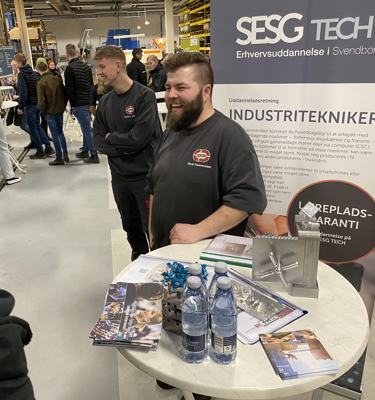
Ricki Rasmussen has stepped into the role, taking over the responsibility from his former apprenticeship coordinator, Paw Schack, with whom he built a close, trusting relationship during his apprenticeship at JEROS. Ricki is, in fact, trained within the company. He completed his apprenticeship as an adult learner and is a certified industrial technician.

That background means Ricki does not just understand our internal training programs in theory. He has experienced them firsthand – with all the responsibility, expectations, and personal challenges that come with being an apprentice.

Because of this, Ricki has in-depth knowledge of every aspect of how we train apprentices at JEROS, from professional requirements to the importance of being met with clarity, respect, and understanding throughout the process.

Today, Ricki is responsible for ensuring that apprentices and students at JEROS experience a safe, structured, and meaningful training journey. A journey where school and hands-on training are closely connected, and where no one is ever left on their own.

Please read on below

Our apprentices and students must gain confidence and pride in their craft

At JEROS, it has always been part of our DNA to offer training tailored to each individual's needs and professional level. We do this by developing clear action plans and training pathways that help apprentices and students reach their goals in the best possible way

"As Apprenticeship Coordinator, I share responsibility for ensuring that all apprentices and students complete their education – regardless of trade. That responsibility spans from the initial planning of the program to ongoing follow-ups, final evaluations, and exams.

From the very beginning, we work systematically with the structure of the training program to make sure apprentices and students learn the right disciplines at the right time. With that structure in place, our shared goal is to ensure they are well prepared for both school periods and their daily work here at JEROS," Ricki explains.

Ricki is also keenly aware that people learn in different ways:

"Some are academically strong, while others learn best by working with their hands – and neither approach is wrong. That is why communication plays such a central role, especially in collaboration between an apprentice and a skilled worker. Expectations, tasks, and responsibilities must always be clear to everyone involved."

At JEROS, we train apprentices with different talents and different starting points. Some thrive on theory and structure, while others develop fastest through practical work. What matters most is not how they learn, but that they are allowed to learn in a way that makes sense for them.

Everyone is challenged!

All apprentices and students at JEROS are challenged – and those with exceptional talent are challenged even more.

Without sufficient challenges, there is a risk of stagnation or loss of motivation. That is why we work deliberately to assign tasks and responsibilities that match each individual's skills and ambitions.

For both apprentices and students, the goal is to build confidence and pride in their craft through their work. That pride grows when they see meaning in their tasks and feel that their work is taken seriously.

When apprentices leave JEROS as fully trained, skilled workers, they should do so with the feeling that they were truly part of the company," Ricki emphasizes.

The article continues below

How does JEROS start a training program?

"A training program at JEROS always begins with thorough planning. Together with the individual, we map out what they will go through and how we best allocate internal resources to support the apprentice or student.

Our mentorship program plays a key role here. All trainees work closely with experienced, skilled workers who are responsible for guiding them both professionally and practically throughout their education," Ricki explains.

Even though a training plan is outlined in advance, Ricki places great importance on involving the apprentice or student in the process: "This is where we plant the seed of shared responsibility and ownership. Apprentices quickly experience that their work is a priority within the company."

Ongoing follow-ups with each individual

"Once the apprentice or student has started, the next phase is about getting to know the company and the profession. During the introductory period – the probation phase – they are given several tasks that we review together.

This marks the beginning of an ongoing evaluation process in which we discuss performance and identify areas for improvement. These follow-up meetings are not only about technical tasks, but just as much about how the individual is handling the responsibility they have been given."

If personal circumstances or school challenges arise, the level of support is adjusted accordingly:

"I listen to both professional challenges and personal situations and adjust our conversations based on what is needed.

Follow-up meetings after each school period are a fixed part of the program. This is where we talk through how the school day went and what to focus on before the next period begins," Ricki explains. 

The article continues below

How does JEROS start a training program?
I completed my own apprenticeship at JEROS, and I know how crucial it is to be met with clear frameworks and people who take responsibility – especially when things are difficult. It's vital to have someone to turn to.

As Apprenticeship Coordinator, I work to ensure that all apprentices and students receive honest feedback and firm support, both professionally and personally. They are not just here to complete an education. They are individuals with different backgrounds and needs, and it's my responsibility to support them throughout their apprenticeship.
Ricki Rasmussen,
Apprenticeship Coordinator, JEROS

What defines a good apprenticeship workplace?

"In my view, a good apprenticeship workplace is one where apprentices are seen as much more than cheap labor.

Apprentices are an asset to their trade and to society. That places a responsibility on companies to take training seriously and invest time, attention, and resources in young people who choose a skilled trade," Ricki says.

In his role, Ricki helps apprentices find their voice so they are heard – within the company, at school, and during external placements.

The goal is always to provide a strong and broad foundation. Training should never be narrow or one-dimensional. Even apprentices training as stainless steel fabricators gain experience across multiple disciplines, from surface finishing and robotic welding to inventory management and machine assembly.

"As part of their education, all apprentices rotate through several departments at JEROS. They take part in assembling the components they have worked on into the machines we ship to customers worldwide. This gives them a clear understanding of how their work connects to the finished product," Ricki explains.

Apprentices are whole people. Not just a resource

For Ricki, apprentices must be treated as entire individuals:

"When personal challenges, grief, or life crises occur, JEROS never turns its back. A difficult personal situation is never seen as the apprentice's problem alone. It is a life circumstance we acknowledge and take into consideration – even when it is not directly related to work."

Ricki is open about his criticism of parts of the apprenticeship culture within the industry. He finds it difficult to understand why young people are sometimes treated poorly during their training – especially at a time when skilled labor is in short supply.

At JEROS, it is therefore a clear priority that apprentices feel safe and supported, both professionally and personally.

The article continues below

At JEROS, people come first

"At JEROS, people always come first. You are met with trust and given responsibility for your own work. If you see an opportunity to improve something, you are encouraged to take initiative and make it happen," Ricki explains.

Having completed his own adult apprenticeship at JEROS, Ricki adds:

"What truly sets JEROS apart from other workplaces is the human support. When I went through a difficult personal situation, the company stepped in and helped – even though it was not required. That level of care makes a real difference."

Watch the video and get an insight into Ricki's approach to craftsmanship and why JEROS is more than just a workplace ⇨

Watch the video and get an insight into Ricki’s approach to craftsmanship – and why JEROS is more than just a workplace ⇨

Apply for an apprenticeship and become a part of Team JEROS:

Become part of Team JEROS

We’re always looking for skilled hands and sharp minds – and ideally, both in one. Whether you bring years of experience or are just starting your journey in the industry, we’d love to hear from you. If your dream job at JEROS isn’t currently listed, feel free to send us an open application anytime.